Doraji Sikdang in Goheung: Stingray Hoe at a Local Gem
The first slice of yellow stingray didn’t taste like fish at all. It tasted like beef — specifically, like the cool, iron-rich tang of yukhoe, the Korean raw beef tartare. I had to chew it twice to convince my mouth it was actually seafood. That moment, in a small graffiti-walled restaurant in Goheung, is the kind of thing I came down here looking for.
Why Goheung, and Why This Place?
Goheung (고흥군) isn’t on most foreign visitors’ radar, and honestly, it’s not on most Korean visitors’ radar either. It’s a quiet peninsula at the southern tip of Jeollanam-do, roughly four and a half hours from Seoul by car, surrounded by water on three sides. People come here for two things: the Naro Space Center, and the seafood. Mostly the seafood.
Google Map: https://maps.app.goo.gl/5jpW88TirXEUMa138
Doraji Sikdang (도라지식당) is the kind of place you’d never find unless someone told you about it. From the outside it looks like a thousand other rural Korean eateries — slightly faded sign, plastic-glass door, the unmistakable patina of a nopo (노포), the Korean word for an old, well-worn restaurant that’s been quietly doing its thing for years. But the moment I stepped inside, I knew I was in for something more interesting than a generic country meal.
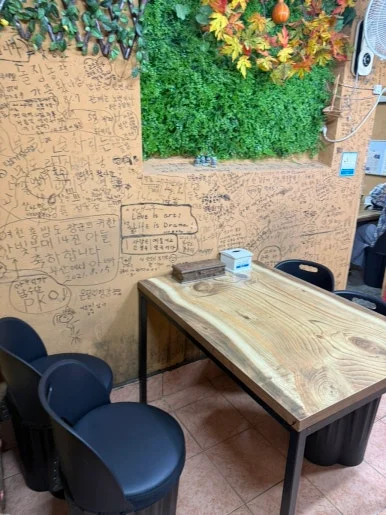
The walls. Every flat surface in the dining nook was inked with black marker — handwritten messages, names, dates, little drawings, the occasional English scrawl among a sea of Korean signatures. It’s a tradition at certain Korean restaurants where regulars and travelers leave their mark, almost like a guestbook that grew until it ate the entire wall. Above the messages, someone had built a little vertical garden — fake green hedges with red and orange maple leaves tucked in, even a small pumpkin perched up top. It shouldn’t have worked aesthetically, but it did. Cozy, lived-in, like eating at someone’s slightly eccentric aunt’s house.
Getting There
Let me be straightforward: Goheung is not a casual day trip from Seoul. The most realistic route is KTX from Seoul Station to Suncheon (about 2.5 hours), then a rental car or intercity bus down to Goheung (another hour-plus). If you’re already exploring Jeolla-do — say, doing Yeosu or Suncheon — adding Goheung to your itinerary is much more reasonable.
Doraji Sikdang sits in the town center area of Goheung-eup. There’s no subway here, no convenient tourist shuttle. You drive, or you taxi from the local bus terminal. That inaccessibility is part of why the food still tastes the way it does — the kitchen isn’t catering to tour buses.
The Star: Yellow Stingray Hoe
We ordered the hwang-gaori hoe (황가오리회), yellow stingray sashimi, large size, at 50,000 KRW (~$38 USD). Stingray is a regional specialty along Korea’s southwest coast — most foreigners associate it with hongeo (홍어), the famously fermented stingray that smells like ammonia and divides every dinner table that encounters it. But this is the unfermented version. Fresh. Raw. Completely different animal, in terms of taste experience.
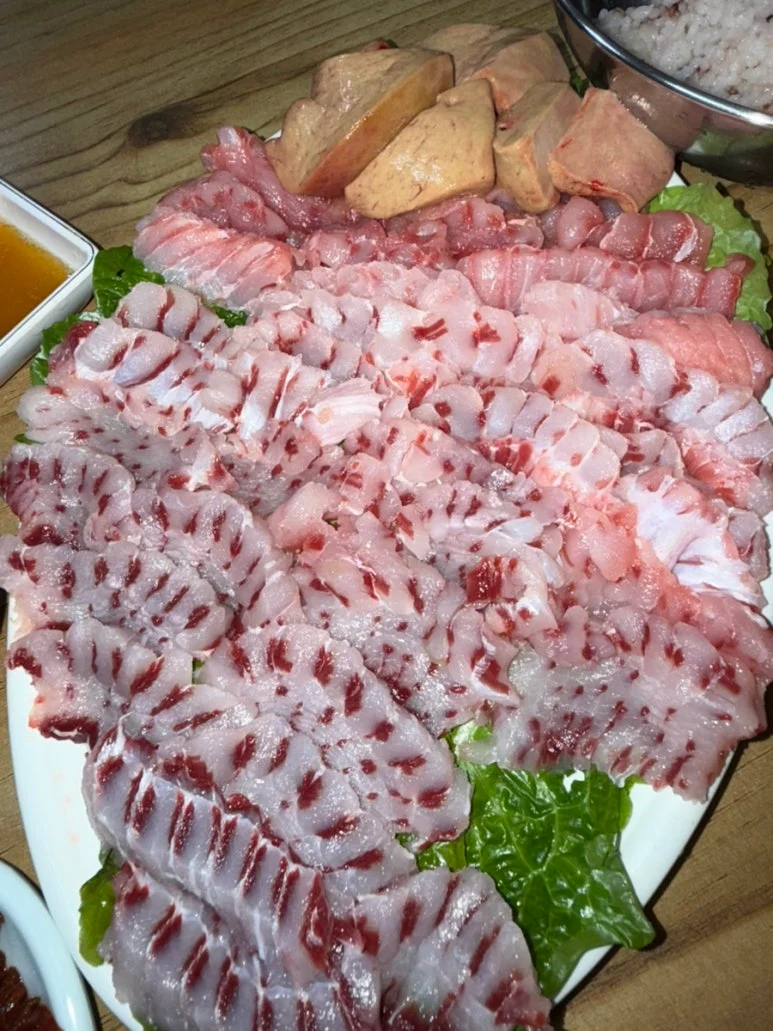
The platter came out generous and glistening — translucent pinkish-white slices fanned across green perilla leaves, with deep crimson bloodlines running along the edges of each piece. The flesh was scored in fine ridges, the way good Korean hoe is always cut to break up the chewiness. At the top of the platter sat the surprise: cubes of stingray liver, dense and rich-pink-red.
The flesh itself had this incredible meatiness. Cool, slightly chewy, with a clean mineral finish. If you’ve had Korean yukhoe (raw beef), you’ll know exactly what I mean — there’s that same iron-and-butter quality, just lighter. Closest comparison for Western readers might be a very fresh tuna belly, but firmer, less fatty, more savory.
Then the liver. Oh, the liver.
I dipped a cube in the amber sauce (a chogochujang-based dip, sweet-tangy with a chili kick) and bit down. It melted. I’m not exaggerating — it dissolved on my tongue with the same unctuous, slightly metallic richness as foie gras. That’s the only honest comparison I can give. If you’ve ever had a properly seared lobe of duck liver in Paris, the texture is genuinely in that family. Except this came out of the sea, off a peninsula in Jeolla-do, served casually next to a stainless steel bowl of multigrain rice.
And the Sole Muchim — Don’t Skip It
We also ordered seodae hoe (서대회), sole sashimi, at 30,000 KRW (~$23 USD). Now, in Goheung and the surrounding region, seodae hoe almost always means seodae hoe-muchim — the sole isn’t served as plain sashimi but tossed in a spicy-sweet-vinegary sauce with julienned vegetables, similar to a Korean raw fish salad. It’s a Jeolla regional dish that’s hard to find elsewhere.

It arrived bright red-orange, the sole pieces small and chewy, the sauce hitting all four corners of your tongue at once — sweet, sour, spicy, umami. The vinegar was assertive but not aggressive. The fish had this satisfying springy bite. I could honestly have eaten a whole bowl of it over rice. Calling it transcendent feels dramatic, but in the moment, it kind of was.
The kitchen here is open, by the way — you can watch the cooks work. I appreciated this more than I expected to. The prep area was clean, organized, no shortcuts visible. For a nopo with graffiti walls, the back-of-house discipline was reassuring.
A Small Cup of Makgeolli
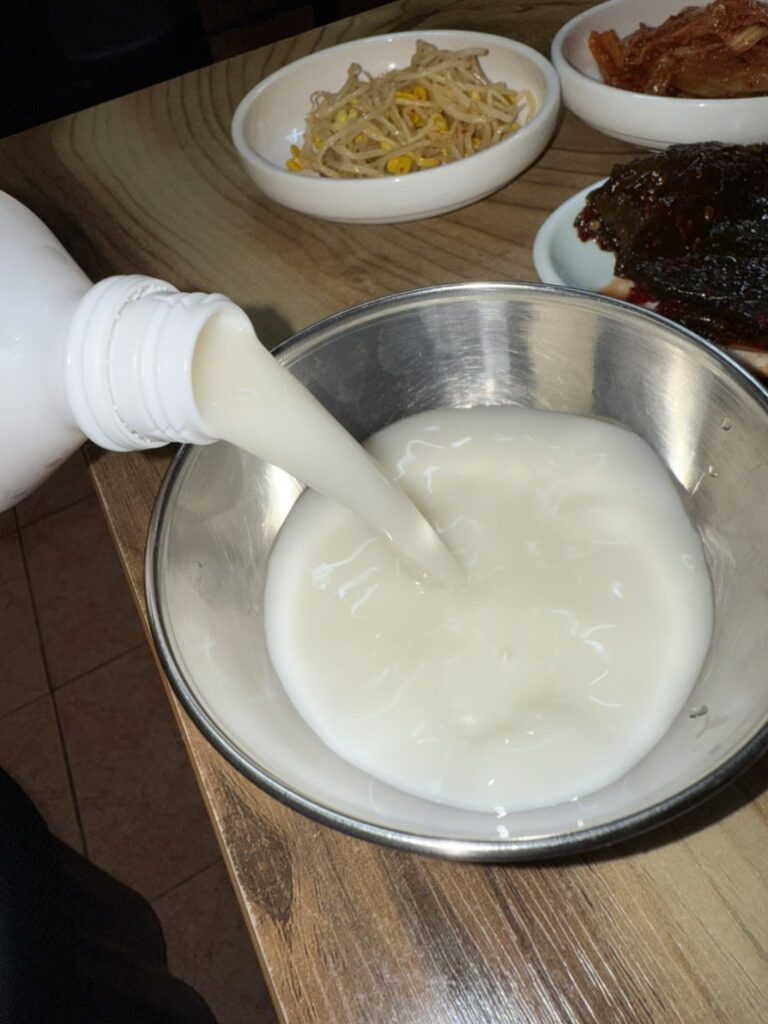
We also got a bottle of makgeolli — Korean unfiltered rice wine, milky-white, lightly fizzy, somewhere between sake and a very mild beer in alcohol content. The one they served was on the sweeter end, slightly syrupy, with a clean finish. It went perfectly with the stingray. Something about the cold, faintly funky rice wine cut through the richness of the liver and balanced out the chili in the sole. This is one of those pairings that feels obvious only after you’ve had it.
Atmosphere and Who It’s For
The space is small. Maybe seven or eight tables, give or take. The corner nook with the graffiti wall is the most charming spot — request it if you can. Lighting is warm, slightly dim. The vibe is firmly local: middle-aged regulars, a couple of families, the owner moving between tables in that comfortable way that says she’s been doing this for a while.
This is a great place for:
- Couples on a slower, more curious kind of trip (not a polished date night)
- Small groups of friends who want to try regional Korean food properly
- Solo travelers who don’t mind being the only foreigner in the room
It’s probably not the place for: picky eaters who don’t do raw fish, families with very young kids, or anyone in a rush.
Price and Value
We spent about 80,000 KRW (~$62 USD) on food before drinks, for two people, with leftovers. For the quality and quantity of seafood — wild yellow stingray and fresh sole are not cheap ingredients anywhere — this is a strong value. In Seoul, a comparable platter at a Gangnam hoe restaurant would easily run double. The makgeolli was a few thousand won extra and barely registered on the bill.
No English menu, as far as I noticed. Translation apps will handle it fine, but if you can manage the names hwang-gaori hoe and seodae hoe, you’ll be set.
Tips for Visiting
A few practical things if you’re planning to go:
- Best time: Lunch is calmer than dinner. Stingray is available year-round, but the late autumn through winter season tends to be when locals consider it best.
- What to order: If it’s your first time, just get the hwang-gaori hoe (medium if you’re two people who don’t drink much, large if you’re hungry or drinking) and the seodae hoe-muchim. That’s the pairing.
- Cash and card: Korean cards are accepted, but always keep some cash in rural Korea just in case.
- Don’t skip the wall: If you’re a regular-feeling type or just want to leave a mark, ask the owner for a marker. Adding your name to the wall is part of the experience.
Goheung isn’t going to show up on most travel listicles, and Doraji Sikdang isn’t going to trend on Instagram. That’s exactly why I wanted to write about it. Some of the best meals I’ve had in Korea have been in places like this — small, slightly worn, run by people who care more about the fish than the lighting. If your travel plans bring you anywhere near the southern Jeolla coast, take the detour. Order the stingray. Try the liver. Trust the wall.